
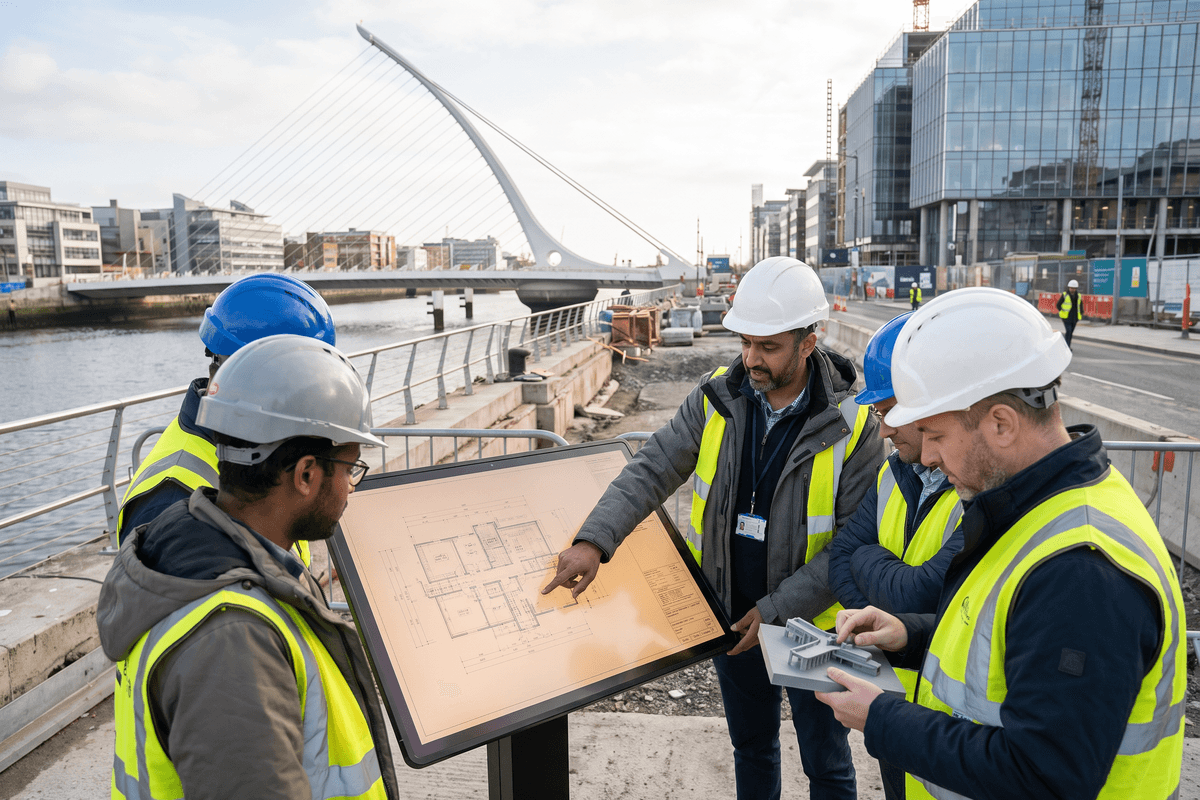



For years, the defining lament of Ireland’s engineering and construction sector wasn't a lack of capital or ambition, but the glacial pace of planning, procurement, and mobilization. In 2026, that narrative is being aggressively rewritten. Driven by unprecedented legislative interventions to fast-track critical infrastructure and a simultaneous leap in digital project delivery, the Irish engineering landscape is entering what can only be described as the 'Delivery Era.' The bottleneck has officially shifted from the planning desk to the site, fundamentally changing how firms recruit, operate, and innovate.
We are seeing this transformation play out simultaneously across heavy civil engineering, advanced manufacturing, and commercial building services. From massive water infrastructure upgrades in the North West to automated medtech production lines in Galway, the mandate is clear: execute faster, build smarter, and digitize the delivery.
Mobilizing the Regions: The Reality of Fast-Tracked Infrastructure
The most immediate catalyst for this shift is a watershed policy decision from the State. The Government's recent move to designate nine major transport, water, and energy projects as Ireland's first 'critical infrastructure schemes' gives them priority access to planning and engineering approvals. This includes long-debated megaprojects like MetroLink and the Galway Ring Road.
While the headlines focus on the capital and major urban centers, the engineering reality is highly regionalized. The fast-tracking of national water upgrades, for instance, is triggering immediate, boots-on-the-ground mobilization in areas outside the traditional Dublin-Cork axis.
A prime example is unfolding in the North West. Following the signing of high-profile water sector contracts, civil engineering and building contractor Farrans has launched an aggressive recruitment drive in Donegal for civil engineering personnel to deliver future Uisce Éireann projects. This isn't speculative hiring; it is the direct, localized impact of unblocking the national infrastructure pipeline.
"When legislative barriers fall, the pressure immediately transfers to the talent pipeline and supply chain. Firms that secure these critical contracts must pivot from procurement mode to rapid, regionalized deployment."
The Capacity Challenge
This surge in approved projects creates a new set of challenges for engineering leaders. Below is a breakdown of how the shift from traditional to fast-tracked delivery is impacting operational demands:
| Project Delivery Phase | Traditional Paradigm | 2026 Fast-Tracked Reality |
|---|---|---|
| Planning & Approval | Multi-year delays, cyclical holding patterns. | Priority processing, creating sudden project starts. |
| Resource Allocation | Centralized teams waiting on green lights. | Aggressive regional recruitment (e.g., Farrans in Donegal). |
| Execution Methodology | Linear, siloed construction management. | Heavy reliance on digital twins and concurrent engineering. |
Digitalization: The Backbone of the Next Growth Phase
You cannot fast-track a megaproject using analog management. As another 12 months of sector growth is forecast for 2026, industry analysts note that technology investment and digitalization will be the primary indicators of success in Ireland's construction and civil engineering industry.
Firms taking on these newly fast-tracked Uisce Éireann or transport projects are realizing that throwing more bodies at a site is no longer sufficient—or even possible, given the tight labor market. Instead, the focus has shifted to technological leverage. This means:
- BIM and Digital Twins: Moving beyond 3D modeling into 4D (scheduling) and 5D (costing) integrations to prevent clashes before breaking ground.
- Automated Site Monitoring: Utilizing drone surveys and IoT sensors to track earthworks and material deliveries in real-time.
- Cloud-Based Project Delivery: Ensuring that a civil engineer in Donegal and a project manager in Dublin are operating from a single source of truth, minimizing rework.
Micro-Innovations Driving Macro-Sustainability
While heavy civil projects dominate the skyline and the national budget, the push for accelerated, efficient engineering is equally potent within the built environment. As we construct new infrastructure, the retrofitting and optimization of existing commercial spaces remains a critical engineering frontier, heavily influenced by sustainability mandates.
Consider the often-overlooked energy footprint of building services. FAIN Ireland’s recent launch of the ION Green lift system perfectly encapsulates this trend. By utilizing innovative regenerative drives and lightweight materials, the technology slashes lift electricity use by up to 96%. Furthermore, it is designed to make installation significantly more accessible and affordable for existing buildings across Ireland.
For MEP (Mechanical, Electrical, and Plumbing) engineers, this represents a paradigm shift. Sustainability is no longer just about the energy source; it is about radical efficiency at the component level. Innovations like ION Green prove that high-impact environmental engineering doesn't always require massive structural overhauls—sometimes, it just requires smarter machinery.
Advanced Manufacturing: Automating the Value Chain
The theme of technological leverage extends far beyond construction. In Ireland's globally recognized medtech and advanced manufacturing sector, companies are fundamentally rethinking their production lines to combat high costs and improve precision.
In Galway, TE Connectivity's Advanced Technology Group has introduced a new automated 3D printing process to manufacture catheter shafts. By replacing higher-cost, labor-intensive manual assembly with advanced additive manufacturing, they are streamlining production while maintaining the microscopic tolerances required for life-saving medical devices.
This development in Galway is highly indicative of where Irish manufacturing engineering is heading:
- Moving Up the Value Chain: Transitioning human capital away from repetitive assembly toward process engineering and quality assurance.
- Reshoring Complex Production: By automating and utilizing 3D printing, firms can keep complex manufacturing in Ireland rather than outsourcing to lower-cost labor markets.
- Agile Prototyping: Additive manufacturing allows for rapid iteration of medical devices, speeding up the R&D cycle.
Conclusion: The Convergence of Speed and Sophistication
As we navigate the latter half of 2026, the throughline connecting Farrans' recruitment in Donegal, the fast-tracking of MetroLink, FAIN's ultra-efficient lifts, and TE Connectivity's 3D-printed catheters is unmistakable. Irish engineering is no longer characterized by a holding pattern of planning delays and manual processes.
We have entered a phase where the legislative roadblocks have been cleared, leaving the industry with a profound responsibility to deliver. Whether it is a site manager deploying digital twins to lay water pipes in the North West, or an automation engineer optimizing a 3D printer in Galway, the future of the sector relies on the seamless integration of human expertise and digital efficiency. For engineering professionals in Ireland, the planning phase is over. It is time to execute.