
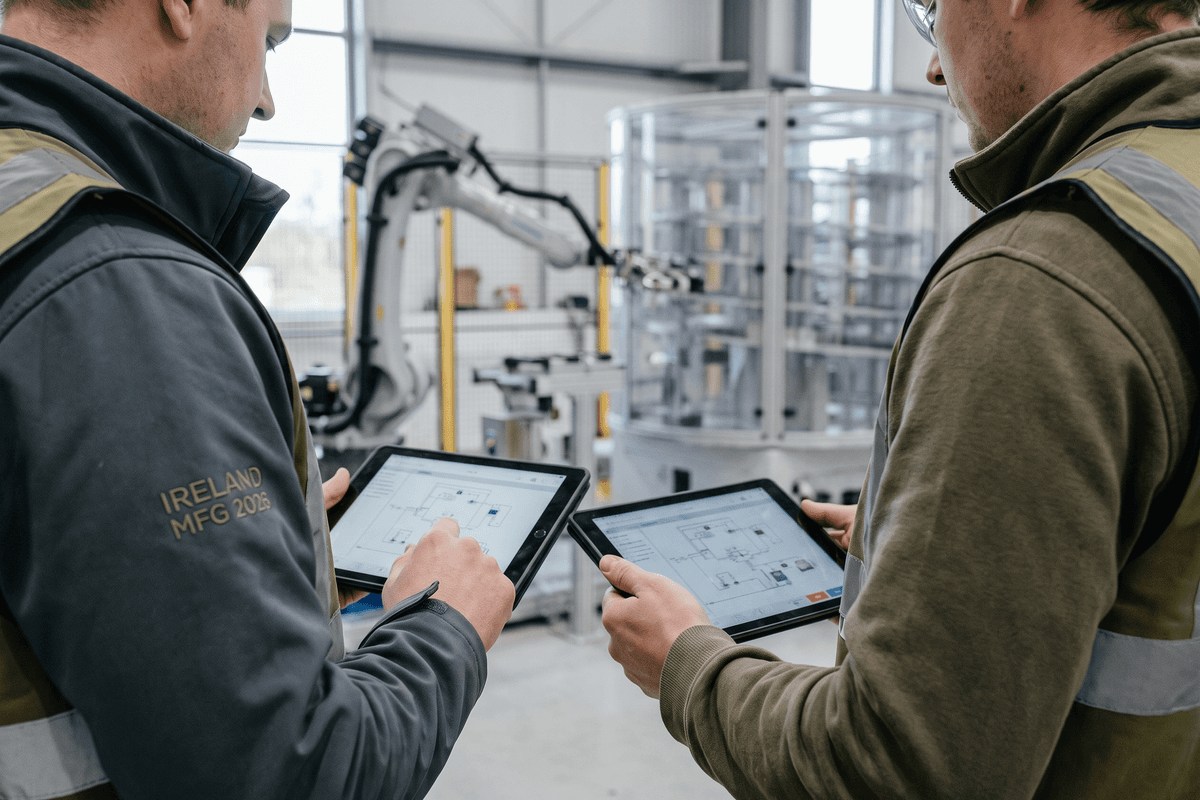



On production floors from Galway’s medical device corridor to the biopharma and heavy engineering hubs across Munster and Leinster, Ireland’s manufacturing sector is undergoing an operational overhaul. While earlier years were defined by exploratory digitalisation and isolated robotic trials, 2026 marks the moment where automation, circular design, and deep tech convergence become structural necessities. As chronicled in the July/August 2026 edition of Irish Manufacturing Magazine, Irish engineering leaders are navigating a tri-fold mandate: deploying intelligent automation, slashing lifecycle carbon footprints, and mastering advanced technological architectures under tightening regulatory and supply chain constraints.
For plant managers, process engineers, and systems architects across the island, this transition requires moving beyond legacy automation paradigms toward responsive, resilient cyber-physical production environments capable of dynamic retooling and granular energy optimisation.
The Automation Imperative: From Isolated Cobots to Autonomous Orchestration
Automation in Irish manufacturing is no longer measured simply by the number of articulated robotic arms or cobots installed along an assembly line. Instead, the focus has pivoted toward autonomous orchestration—the seamless linking of automated guided vehicles (AGVs), vision-guided robotics, automated storage and retrieval systems (ASRS), and real-time execution engines.
In high-mix, low-volume (HMLV) precision engineering—a hallmark of Ireland’s indigenous supply base—fixed automation has historically struggled to deliver a compelling return on investment. However, software-defined automation platforms and rapid-changeover tooling are reshaping this dynamic. By coupling collaborative robotics with adaptive computer vision, facilities can now transition between bespoke component batches in minutes rather than hours, reducing changeover scrap and eliminating manual calibration bottlenecks.
"The engineering challenge has shifted from 'Can we automate this task?' to 'How does this automated node dynamically communicate with upstream inventory and downstream quality verification in real time?' Integration is the new battleground."
Crucially, this integration is being powered by open communication standards like OPC UA over TSN (Time-Sensitive Networking), enabling Irish plants to dismantle vendor lock-in and establish interoperability across multi-generation legacy hardware.
Decarbonisation and Resource Efficiency: Engineering the Circular Plant
Environmental performance is no longer a corporate sustainability checkbox; it has become an unforgiving engineering constraint. Ireland’s aggressive national decarbonisation targets, coupled with tightening EU Corporate Sustainability Due Diligence mandates, mean plant engineers must account for every kilowatt-hour and kilogram of raw material consumed.
1. Closed-Loop Thermal and Energy Management
Industrial facilities are increasingly deploying high-temperature industrial heat pumps, mechanical vapour recompression (MVR), and direct heat-recovery exchangers on exhaust and effluent streams. In energy-intensive pharmaceutical synthesis and precision metallurgy, capturing low-grade waste heat and upgrading it for cleanroom HVAC or process water pre-heating is yielding double-digit efficiency gains.
2. Additive Manufacturing and Material Minimisation
Industrial 3D printing—once restricted to rapid prototyping—is now embedded directly into end-use production workflows. Through generative design algorithms, manufacturing engineers are producing lightweighted jigs, fixtures, and structural machine components that use up to 40% less raw material while matching the structural rigidity of conventionally machined titanium and stainless steel alloys.
Strategic Technology Integration: Digital Twins and Edge Intelligence
The convergence of Industrial Internet of Things (IIoT) sensors, edge computing, and digital twin technology is providing Irish manufacturing engineers with unprecedented visibility into asset degradation and process drift. The era of scheduled maintenance intervals is rapidly giving way to condition-based predictive reliability.
By processing high-frequency acoustic and vibration data directly at the machine edge rather than transmitting massive raw datasets to the cloud, edge controllers can identify microscopic bearing wear or spindle misalignment before catastrophic failure occurs. When paired with digital twin models, process engineers can simulate tooling speeds, thermal loads, and cycle times in a virtual environment, stress-testing operational limits without risking physical equipment downtime.
Benchmarking Ireland’s Manufacturing Engineering Priorities (2026/2027)
To understand where capital expenditure and engineering talent are being concentrated, consider the shifting focus across core manufacturing engineering domains:
| Engineering Domain | Traditional Approach (2020–2023) | Modern Standard (2026+) | Primary Operational Impact |
|---|---|---|---|
| Plant Automation | Fixed robotics; isolated PLC control islands | Mobile cobots; software-defined PLC/MES integration | High operational agility and reduced batch changeover time |
| Asset Maintenance | Preventative schedule; reactive emergency repairs | Edge AI vibration/thermal monitoring; prescriptive maintenance | Near-zero unplanned downtime; extended machine tool lifecycle |
| Energy Tracking | Facility-level monthly utility aggregation | Machine-level sub-metering tied to unit batch records | Granular Scope 1 & 2 verification; optimised peak shaving |
| Quality Control | Post-process manual batch sampling | In-line automated optical inspection (AOI) with real-time feedback | Immediate defect isolation; reduction in raw material scrap |
The Human-in-the-Loop Reality: Developing Systems-Level Engineers
While the pace of technological adoption is accelerating, the ultimate constraint facing Ireland's manufacturing sector remains the availability of specialised engineering talent. The traditional bifurcation between mechanical engineers, electrical technicians, and software developers is proving obsolete on the modern smart manufacturing floor.
Today’s high-performing facilities require systems engineers who understand mechanical kinematics, industrial networking protocols, data science, and functional safety standards simultaneously. Key competency shifts currently in demand include:
- OT/IT Convergence: Bridging the gap between Operational Technology (PLCs, SCADA, actuators) and Information Technology (cloud analytics, ERP, enterprise cybersecurity).
- Robotic Safety & Collaborative Ergonomics: Ensuring ISO 10218 and ISO/TS 15066 compliance for human-robot shared workspaces without degrading cycle throughput.
- Data Engineering for Physical Systems: Cleaning, contextualising, and structuring sensor data streams to feed automated quality and predictive maintenance algorithms.
Looking Ahead: Building Ireland’s High-Value Manufacturing Moat
Ireland has long maintained a competitive edge as a global hub for high-value advanced manufacturing, but relying solely on established FDI presence is not enough. The future resilience of the sector depends on how effectively domestic supply chains and tier-one facilities absorb smart automation, embed circular engineering principles, and cultivate multidisciplinary engineering capability.
As industry publications like Irish Manufacturing Magazine make clear in their mid-2026 assessments, the engineering choices made today on the plant floor will dictate Ireland’s industrial competitiveness for the next decade. For Ireland's engineers, the mandate is clear: connect the data, close the loops, and build the autonomous, sustainable plant of tomorrow.