
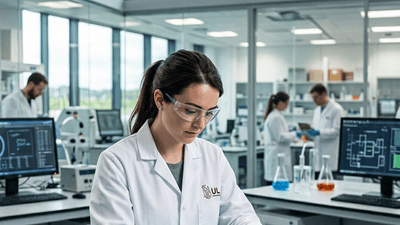



The transition to a zero-carbon economy hinges on a single, stubborn bottleneck: energy storage. For decades, the global engineering community has chased the holy grail of battery technology—seeking systems that are safer, charge faster, and hold more power without relying on increasingly scarce raw materials. This month, the epicenter of that global pursuit shifted to the Mid-West of Ireland.
Scientists at the University of Limerick (UL) have achieved a world-first battery breakthrough by successfully combining multiple ion types in a single storage mechanism. This is not merely an academic milestone; it is a fundamental disruption in how we approach energy storage, with massive implications for everything from consumer electronics to grid-scale renewable energy infrastructure.
However, as any seasoned engineering professional knows, a laboratory breakthrough is only the first step in a long, complex journey to commercial deployment. As Ireland cements its reputation as a global R&D powerhouse, the sector must simultaneously navigate volatile global supply chains, international acquisitions, and a persistent talent shortage. Here is what the UL discovery—and the broader market dynamics—mean for Irish engineering in 2026.
The UL Breakthrough: Rewriting the Rules of Energy Storage
Traditional lithium-ion batteries rely on a single type of ion moving back and forth between the anode and cathode. While effective, this technology is approaching its theoretical limits in terms of energy density and charging speed. The UL research team's breakthrough involves a novel architecture that allows for the combination and simultaneous movement of different ion types.
Why "Combining Ions" Matters
By leveraging multiple charge carriers, the UL scientists have effectively bypassed the chemical traffic jams that cause traditional batteries to degrade over time or overheat during rapid charging. For engineering professionals working in renewable energy integration or electric vehicle (EV) infrastructure, the practical implications are profound:
- Enhanced Grid Stability: Multi-ion batteries could absorb and discharge power much faster than current grid-scale batteries, making them ideal for smoothing out the intermittent nature of wind and solar power.
- Reduced Reliance on Critical Minerals: By diversifying the types of ions used, manufacturers could potentially reduce their dependence on geopolitically sensitive materials like cobalt and highly refined lithium.
- Extended Lifespans: Reduced chemical stress during charge cycles translates to batteries that last longer, fundamentally altering the lifecycle cost analysis for major infrastructure projects.
"This world-first achievement at the University of Limerick demonstrates that Irish institutions are not just participating in the global green energy transition; they are actively writing its foundational science."
Fueling the Ecosystem: State Support for Green Innovation
The UL discovery did not happen in a vacuum. It is the result of a deliberate, sustained focus on environmental and climate research within Ireland. Reinforcing this ecosystem, the Environmental Protection Agency (EPA) recently announced €10.5 million in new funding for environmental and climate research.
This funding call is an open invitation to the research community and private engineering partnerships to develop innovative projects that support national environmental policies. The capital injection is strategically targeted to bridge the gap between theoretical R&D and practical, policy-driven implementation.
| Funding Focus Area | Engineering Application | Impact Timeline |
|---|---|---|
| Climate Mitigation | Grid integration of novel storage tech (like UL's batteries), smart grid deployment. | Medium to Long-term (3-7 years) |
| Circular Economy | End-of-life recycling processes for legacy lithium-ion and new multi-ion batteries. | Immediate to Medium-term (1-5 years) |
| Water & Natural Capital | Sustainable extraction and processing of battery materials; reducing industrial water footprints. | Immediate (Ongoing) |
Global Headwinds: Geopolitics and the Supply Chain Reality
While R&D flourishes, the physical reality of building infrastructure in 2026 remains fraught with external risks. A sobering reminder of this vulnerability comes from recent geopolitical escalations. A new economic report warns that the escalating US-Israel-Iran conflict in the Gulf region will severely hit the Irish construction sector and large-scale infrastructure projects.
For project managers and civil engineers, the fallout is immediate and tangible. The Gulf region is a critical artery for global shipping and raw material supply. Disruptions here mean:
- Spiking Material Costs: Energy-intensive materials like steel and cement are highly sensitive to oil price shocks triggered by Middle Eastern instability.
- Delayed Component Delivery: Specialized electrical components required for green energy projects often transit through impacted maritime routes, leading to unpredictable project timelines.
- Contractual Friction: Fixed-price contracts signed in 2024 or 2025 are now under immense pressure, forcing engineering firms to renegotiate terms or absorb punishing losses.
This creates a stark dichotomy: Ireland has the intellectual capital to design the future of energy, but the physical supply chains required to build it remain tied to volatile global geopolitics. Resilience engineering—designing supply chains and project timelines with built-in redundancy—is no longer a luxury; it is a survival requirement.
Commercializing Expertise: The All-Island Appeal
Despite these supply chain headwinds, international confidence in Irish engineering expertise remains exceptionally high. We are seeing a distinct trend of global heavyweights acquiring local firms to capture specialized knowledge, particularly in the electrical and energy sectors.
A prime example is the recent news that Northern Ireland-based TES Group has been acquired by French multinational Legrand. TES Group, a specialist in electrical engineering and water/wastewater treatment power solutions, represents the kind of highly specialized, applied engineering that is critical for deploying new energy technologies.
This acquisition—providing an exit for Foresight Group—highlights a broader trend: the all-island engineering economy is viewed as a premium asset by European conglomerates. As breakthroughs like UL's battery technology mature, firms like TES Group will be the boots on the ground integrating these innovations into municipal and industrial power systems. For independent Irish engineering firms, the message is clear: deep specialization in green tech integration makes you a highly attractive target for global investment.
The Talent Bottleneck: A Clear Route Forward
Who will design the new supply chains? Who will integrate the UL battery tech into the national grid? Who will manage the EPA-funded environmental projects? The answer to all these questions is currently constrained by a severe talent shortage.
The industry's growth is outpacing its headcount. However, a recent barometer report by Engineers Ireland highlights a clear route to more talent: addressing the gender imbalance. Historically, engineering in Ireland has heavily skewed male, effectively leaving half the population's talent pool untapped.
To capitalize on the current wave of R&D and commercial investment, engineering firms must aggressively pivot their recruitment and retention strategies. The report suggests several practical steps for firms:
- Implement Blind Hiring: Remove identifying information from initial CV screenings to eliminate unconscious bias.
- Promote Visible Role Models: Ensure female engineers are visibly leading high-profile projects, such as the new battery technology integrations.
- Flexible Work Structures: Move beyond rigid site hours where possible, embracing hybrid models that support work-life balance for all parents and caregivers.
- Early Pipeline Engagement: Partner with secondary schools to demystify engineering and showcase the environmental and societal impact of the profession.
Conclusion: Navigating the Dual Reality of 2026
The engineering landscape in Ireland today is defined by a fascinating dual reality. On one hand, we are witnessing era-defining R&D, epitomized by the University of Limerick's world-first battery breakthrough and supported by robust EPA funding. On the other hand, we face the gritty, operational realities of global geopolitical conflicts disrupting our construction supply chains, and a talent pipeline that urgently needs diversification.
For engineering professionals and firm leaders, success over the next decade will require balancing these two extremes. We must be visionary enough to adopt and commercialize cutting-edge technologies, while remaining pragmatic enough to build resilient supply chains and inclusive workplaces. Ireland has proven it can engineer the future; the task now is to ensure we have the materials, the commercial structures, and the diverse talent required to build it.