
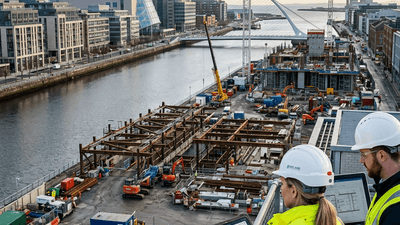



For years, the narrative surrounding Ireland’s infrastructure sector has been a tug-of-war between unprecedented national ambition and the frustrating realities of delivery bottlenecks. But as we move deeper into the decade, a new narrative is taking hold—one defined by structural maturity, aggressive capital investment, and the integration of next-generation technologies. The Irish engineering landscape is no longer just expanding; it is scaling up to meet the complexities of modern project delivery.
This week’s developments offer a perfect cross-section of this evolution. From massive domestic investments in academic research to strategic foreign acquisitions and the deployment of artificial intelligence in regulatory workflows, the sector is tooling up. For engineering professionals and firm leaders across the country, these shifts signal a fundamental change in how infrastructure will be designed, funded, and executed in Ireland.
The Domestic Anchor: Galway's New Mega-Unit
One of the most significant indicators of domestic confidence is the commitment of local industry giants to long-term research and development. Civil engineering firm Ward & Burke is set to confirm a multi-million euro investment in the University of Galway to establish a new Centre for Infrastructure Research and Innovation.
This "mega engineering unit" represents a departure from standard corporate sponsorships. It is a targeted effort to bridge the gap between theoretical civil engineering and boots-on-the-ground execution. By embedding a commercial powerhouse like Ward & Burke within the academic ecosystem, the University of Galway is positioning itself as a central node for infrastructure innovation in the West of Ireland.
What This Means for Civil Professionals
- Applied R&D: Research will likely focus on immediate, practical challenges such as sustainable materials, trenchless technologies, and climate-resilient water infrastructure—areas where Ward & Burke already excels.
- Talent Pipelines: For engineering students and mid-career researchers, the centre offers a direct conduit to one of Ireland's most active civil contractors, ensuring that the skills developed in academia match the immediate needs of the site.
- Regional Rebalancing: This investment further solidifies the trend of high-value engineering capacity establishing deep roots outside of Dublin, creating sustainable, long-term career opportunities in the West.
"The establishment of a mega-unit dedicated to infrastructure research is not just an academic milestone; it is a clear signal that Irish contractors are looking beyond current project lifecycles to secure their technological edge for the next decade."
Foreign Capital and Market Consolidation
While domestic firms are investing in future capabilities, global players are moving aggressively to capture current market share. In a major move for the consultancy sector, Canadian engineering and project management giant AtkinsRéalis has acquired Irish engineering consultant Patrick J Tobin & Co..
Tobin, a well-established name in Irish engineering with strong footholds in water, environmental, and civil infrastructure, provides AtkinsRéalis with immediate, deep-rooted local expertise. This acquisition is a strategic play to capture a larger slice of Ireland's lucrative infrastructure market, which is heavily buoyed by the National Development Plan (NDP).
The Ripple Effects of Consolidation
When Tier-1 global firms acquire regional stalwarts, it changes the competitive dynamics of the local market:
- Enhanced Bidding Power: The combined entity will have the local relationships and historical context of Tobin, backed by the massive balance sheet and specialized global expertise of AtkinsRéalis. This makes them a formidable contender for upcoming state megaprojects.
- Upward Pressure on Standards: Global firms bring international project management frameworks and digital delivery standards (like advanced BIM and digital twins), which will likely force mid-tier Irish firms to accelerate their own digital transformations to remain competitive.
- M&A Appetite: This acquisition proves that successful, well-managed Irish engineering consultancies are highly attractive targets for international capital. Firm owners should view this as a validation of the sector's strength and a potential roadmap for future exit strategies or growth partnerships.
Working Smarter: AI Meets the Regulatory Bottleneck
Capacity isn't just about having more engineers; it's about freeing up the engineers you already have. A notorious drag on infrastructure delivery in Ireland is the sheer volume of compliance and regulatory documentation required.
Enter the Irish AI startup Better Futures, which has recently secured €600,000 in funding to automate engineering documentation workflows in highly regulated industries. By leveraging artificial intelligence to handle the repetitive, high-stakes paperwork required in sectors like water, energy, and civil construction, Better Futures is directly attacking one of the industry's most persistent bottlenecks.
Public Sector Capability: Managing the Billions
Finally, the maturation of the sector is not limited to private enterprise. The state apparatus that funds and oversees these projects is also upskilling. The National Treasury Management Agency (NTMA)—the body responsible for managing Ireland's national debt and state claims, as well as providing financial advisory services for major capital projects—has been awarded the CPD Accredited Employer Standard by Engineers Ireland.
Why does a treasury agency need engineering CPD? Because managing the financial risk of multi-billion euro infrastructure projects requires deep, technical literacy. By committing to continuous professional development for its engineering staff, the NTMA is ensuring that the state remains an informed, capable client. This is crucial for preventing the cost overruns and scope creeps that have historically plagued public works.
The 2026 Shift: A Sector in Transition
To understand the current trajectory of the Irish engineering sector, we can look at how the approach to infrastructure is shifting across multiple domains:
| Domain | The Traditional Approach | The 2026 Shift |
|---|---|---|
| Research & Development | Fragmented, state-dependent funding. | Mega-investments by domestic contractors (e.g., Ward & Burke in Galway). |
| Market Structure | Dominated by independent, mid-sized local firms. | Consolidation via global Tier-1 acquisitions (e.g., AtkinsRéalis acquiring Tobin). |
| Workflow & Compliance | Manual, labor-intensive documentation. | AI-driven automation unlocking engineering capacity (e.g., Better Futures). |
| Public Procurement | Financial oversight separated from technical expertise. | Integrated technical literacy within state financial bodies (e.g., NTMA CPD accreditation). |
Conclusion: A Foundation for the Future
The events of recent weeks paint a vivid picture of an industry undergoing profound, positive structural change. Ward & Burke’s investment in Galway proves that domestic firms are willing to put serious capital behind next-generation research. AtkinsRéalis’ acquisition of Tobin demonstrates the global appetite for Ireland's infrastructure pipeline. Better Futures' funding highlights the critical role of technology in solving our capacity issues, while the NTMA’s accreditation shows a state apparatus committed to technical excellence.
For engineering professionals in Ireland, the message is clear: the scale of our projects is growing, and so too must our capabilities. Whether through academic partnerships, international integration, or artificial intelligence, the sector is building the robust, mature foundations necessary to turn national ambition into concrete reality.