
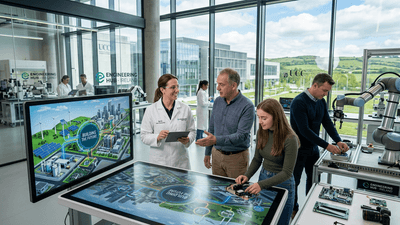



The image of an abandoned historic college finding new life as a high-tech digital campus is more than just a local success story—it is a powerful metaphor for the current trajectory of Ireland’s engineering and technology sector. Across the island, the traditional paradigm of centralized, corporate-owned R&D monoliths is giving way to a more dynamic, distributed model. Today, the cutting edge of Irish engineering is being sharpened in specialized innovation hubs, where industry and academia share not just ideas, but physical infrastructure.
This shift represents a fundamental change in how engineering capabilities are developed, scaled, and sustained. From the revival of Gaeltacht heritage sites to deep-tech semiconductor laboratories and advanced health-tech collaboration spaces, Ireland is constructing a resilient, decentralized engineering ecosystem. For professionals in the field, this evolution promises new career trajectories, unprecedented cross-disciplinary opportunities, and a redefinition of where high-value engineering happens.
The Gaeltacht Goes Digital: Campus Íosagáin
The most striking recent example of this localized innovation strategy has just opened its doors in Baile Bhuirne, Co Cork. Campus Íosagáin, a historic Gaeltacht college, has been meticulously transformed into a €10 million purpose-built digital innovation premises.
This isn't merely a remote working hub; it is a strategic economic engine designed to anchor digital and engineering talent in the region. Expected to create up to 320 full-time jobs, the campus provides the kind of enterprise-grade infrastructure typically reserved for urban tech parks. By embedding this facility within a Gaeltacht community, the project proves that high-level digital engineering and cultural heritage can be mutually reinforcing.
"The transformation of Campus Íosagáin illustrates a critical shift in Irish infrastructure planning: we are no longer asking talent to migrate to the technology; we are building the technological infrastructure where the talent wants to live."
For civil, structural, and network engineers, projects like Campus Íosagáin represent a growing sub-sector: the adaptive reuse of historical structures for high-tech applications. Balancing modern HVAC, high-capacity broadband, and energy-efficient systems with heritage conservation is becoming a highly sought-after engineering competency in Ireland.
Deep Tech and Sovereignty: Tyndall's Semiconductor Push
While Campus Íosagáin focuses on digital enterprise, just an hour away at the Tyndall National Institute in Cork City, the focus is on the atomic level of engineering. Tyndall is in line to receive €4.67 million to support the ASPIRE project, a critical initiative aimed at strengthening Ireland's semiconductor research capability.
The ASPIRE project is designed to provide national capability for growing and analysing ultra-thin semiconductor materials. In an era where geopolitical tensions have exposed the fragility of global semiconductor supply chains, localizing advanced materials research is a matter of strategic economic sovereignty.
Why ASPIRE Matters to the Engineering Sector
- Advanced Manufacturing: As Moore's Law faces physical limitations, ultra-thin materials are the frontier. Engineers skilled in nanofabrication and materials science will find themselves at the center of global technological advancement right in Cork.
- Equipment and Tooling: The €4.67m investment implies significant procurement and commissioning of highly specialized, sensitive laboratory equipment, requiring precision engineering for installation and maintenance.
- Ecosystem Gravity: Deep-tech academic capabilities naturally attract foreign direct investment (FDI) from semiconductor giants who need proximity to cutting-edge research and the graduates it produces.
Bridging the Gap: Health Tech in Galway
The synergy between academia and industry is equally palpable in the West of Ireland, a globally recognized hub for MedTech. Recently, the University of Galway and TE Connectivity unveiled a specialized collaboration facility to support health technology innovation.
Operating through the BioInnovate Ireland programme, this new space is designed to remove the friction between academic theory and commercial engineering. TE Connectivity, a global industrial technology leader, recognizes that the next generation of minimally invasive medical devices requires engineers who understand both the clinical need and the commercial manufacturing constraints.
By creating a dedicated physical space for this collaboration, the University of Galway is ensuring that its biomedical and mechanical engineering students are working on real-world industry problems before they even graduate. For seasoned professionals, these hubs serve as vital networking and upskilling centers, blurring the lines between corporate R&D and academic research.
Securing the Foundation: Trinity's Digital Resilience
All of this regional innovation—whether in enterprise software, semiconductors, or medical devices—relies on a secure digital foundation. Recognizing the increasing vulnerability of our interconnected systems, Trinity College Dublin has launched the Centre for Digital Security and Societal Resilience.
This multidisciplinary research centre is a direct response to the technological, economic, governance, and societal challenges shaping Ireland's digital future. For software, network, and systems engineers, the centre highlights a crucial reality: cybersecurity is no longer a localized IT issue; it is a fundamental engineering parameter.
The TCD centre's focus on "societal resilience" is particularly noteworthy. It acknowledges that when critical infrastructure fails—whether through cyberattack, systemic bugs, or hardware failure—the societal impact is immediate and severe. Engineers are increasingly being asked to design not just for efficiency and scale, but for absolute resilience in the face of hostile actors and unpredictable variables.
Mapping Ireland's Specialized Hubs
To understand the breadth of this localized innovation strategy, we can map these recent developments across their respective domains and regional impacts.
| Location | Innovation Hub / Project | Engineering Focus | Primary Impact |
|---|---|---|---|
| Baile Bhuirne, Cork | Campus Íosagáin | Digital Infrastructure, Enterprise Networks | Regional economic stimulus, adaptive reuse engineering, remote enterprise scaling. |
| Cork City | Tyndall ASPIRE Project | Nanofabrication, Materials Science | Advanced semiconductor R&D, supply chain sovereignty, deep-tech skills development. |
| Galway | BioInnovate (TE Connectivity) | Biomedical, Mechanical, Health Tech | Accelerated commercialization of medical devices, industry-academic synergy. |
| Dublin | TCD Digital Security Centre | Cybersecurity, Systems Engineering | Infrastructure resilience, multidisciplinary threat mitigation, policy-driven engineering. |
Practical Implications for Engineering Professionals
What does this decentralization and specialization mean for the engineer on the ground?
- The End of the "Dublin-Only" Career Path: High-value, deeply technical roles are increasingly dispersed. You can work on cutting-edge semiconductor materials in Cork or advanced health-tech in Galway without compromising your career trajectory.
- The Rise of the "Translational" Engineer: Hubs like BioInnovate require engineers who can speak multiple languages—not just code or CAD, but the languages of clinical healthcare, commercial viability, and academic research. The ability to translate a complex academic breakthrough into a scalable manufactured product is a premium skill.
- Security by Design: As championed by TCD's new centre, every engineering discipline must now incorporate security and resilience from day one. Whether you are designing a physical medical device or a cloud-based enterprise network, threat modeling is now a core engineering competency.
Conclusion
Ireland's engineering landscape is maturing rapidly. By investing in specialized, localized hubs like Campus Íosagáin, Tyndall, and the collaborative spaces in Galway and Dublin, the country is building an ecosystem that is greater than the sum of its parts. This network of innovation ensures that Ireland is not merely a host for multinational corporations, but a sovereign generator of deep-tech intellectual property. For the engineering professionals driving this change, the future is collaborative, resilient, and closer to home than ever before.