
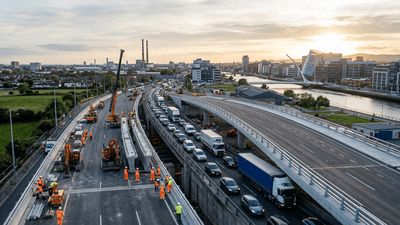



Ireland's economy has long operated like a high-performance engine, but the chassis is beginning to show signs of critical stress. Despite robust fiscal health and unprecedented foreign direct investment, the physical reality of building the nation is failing to keep pace with its economic ambition. According to a stark 2026 report, Deloitte warns that compounding delays in housing construction and critical infrastructure upgrades will severely hinder Ireland's economic growth. For the engineering professionals tasked with designing, managing, and delivering these projects, this is no longer just a macroeconomic talking point—it is a daily operational crisis.
The Anatomy of the Delay
The Deloitte warning does not emerge from a vacuum; it quantifies a frustration that civil, structural, and electrical engineers have been navigating for years. The bottlenecks are not isolated to one sector but are systemic, creating a cascading effect across the entire built environment. When a housing development is stalled, the associated water and grid infrastructure projects are left in limbo. Conversely, when grid capacity upgrades are delayed, high-value commercial and industrial projects cannot proceed.
"The gap between capital availability and capital deployment has become Ireland's most pressing economic vulnerability. If we cannot build the housing required for our workforce, or the infrastructure required for our industries, growth will inevitably stall."
Housing: The Ultimate Catch-22
For the engineering sector, the housing crisis presents a unique paradox. Firms are desperately trying to recruit international engineering talent to help design and manage major infrastructure projects. However, the lack of available, affordable housing makes relocating to Ireland an increasingly difficult proposition for foreign professionals. This exacerbates the existing skills shortage, further delaying the very projects designed to alleviate the housing deficit.
Critical Infrastructure: Grid and Water
Beyond housing, the delays in upgrading the national grid (EirGrid) and water infrastructure (Uisce Éireann) are heavily impacting engineering portfolios. Data centers, pharmaceutical expansions, and advanced manufacturing facilities—the cornerstones of Ireland's FDI strategy—require massive energy and water inputs. When electrical engineers cannot secure grid connection dates for their clients due to overarching infrastructure delays, entire multi-million-euro developments are shelved.
Why Projects Stall: The Engineering Perspective
To understand how to navigate this landscape, engineering leaders must dissect the root causes of these delays. While political and economic factors play a role, the operational hurdles fall squarely into three categories:
- Planning and Regulatory Quagmires: The Irish planning system, including the backlog at An Bord Pleanála and the frequent use of judicial reviews, means project timelines are entirely unpredictable. Feasibility studies expire, and environmental impact assessments must often be redone.
- Supply Chain Volatility: While global supply chains have stabilized since the pandemic, local supply constraints for specialized construction materials remain tight, leading to sudden procurement bottlenecks.
- Resource Allocation: With so many projects trapped in the planning phase, engineering firms struggle to allocate their workforce efficiently. Teams are kept on standby or stretched too thin when multiple delayed projects suddenly receive the green light simultaneously.
Strategic Pivots for Engineering Firms
In light of Deloitte's findings, hoping for swift government reform is not a viable business strategy. Engineering consultancies and contractors must adapt their operational models to survive and thrive in a high-delay environment. The focus must shift toward risk mitigation, front-loaded design, and alternative construction methods.
Embracing Modern Methods of Construction (MMC)
One of the most effective ways to bypass on-site delays is to move construction off-site. Structural and civil engineers must increasingly design for Modern Methods of Construction (MMC). By utilizing prefabricated modules and off-site manufacturing, firms can run the construction phase concurrently with site preparation and planning appeals. This significantly condenses the actual on-site timeline once permissions are granted.
Digital Twins and Advanced Scenario Modeling
When timelines are uncertain, cost control becomes paramount. Utilizing Building Information Modeling (BIM) level 3 and Digital Twins allows engineering teams to model various delay scenarios. If a project is delayed by 18 months, what is the impact on material degradation, cost inflation, and resource availability? Advanced modeling allows firms to present clients with dynamic, risk-adjusted budgets rather than static estimates that will inevitably be blown out of the water.
Comparing Delivery Models
To illustrate the necessary shift in project management, consider the differences between traditional methodologies and the adaptive strategies required in 2026:
| Project Phase | Traditional Approach | Adaptive Engineering Strategy (2026) |
|---|---|---|
| Planning & Design | Linear progression; design finalized before planning submission. | Iterative design; parallel digital twin modeling to adapt to regulatory changes swiftly. |
| Procurement | Just-in-time material ordering post-planning approval. | Early Contractor Involvement (ECI); securing supply chains and off-site manufacturing slots early. |
| Construction | Traditional on-site build, highly vulnerable to weather and labor shortages. | Heavy reliance on MMC, modular assembly, and automated site monitoring. |
The Path Forward
The warning from Deloitte is clear: Ireland's economic future is tethered to its ability to build. While the government must urgently address the systemic planning and funding bottlenecks, the engineering sector cannot afford to wait passively. By embracing technological innovation, advocating for MMC, and fundamentally restructuring how project risk is managed, Irish engineering professionals can provide the resilience needed to keep the economy moving.
The firms that will dominate the next decade of Irish infrastructure will not necessarily be those with the largest workforces, but those with the most agile, adaptable, and forward-thinking engineering strategies. Breaking the bottleneck starts on the drawing board.